
April 11, 2025: A new ham radio conference, WPSD and Pi-Star upgrades, an audio sample from the ANH100 AllStar node, AI in action, an emergency radio, IRLP, and much more.
Overview
Announcing the Zero Retries Digital Conference –The first ZRDC!
RepeaterBook – Repeaters by your travel route, and RepeaterBook to power the ARRL Repeater Directory.
WPSD operating system upgrade announced – W0CHP announced a significant upgrade on April 6th. Also a pi-star beta release.
Node 578492 audio sample – Capturing audio directly into Audacity.
AllScan MA1 microphone adapter – Moving up to a Motorola hand mic.
NotebookLM: Using AllStarLink without owning a physical node – I used AI to gather and summarize some information.
Sangean MMR-88 emergency radio – Affordable and easy-to-use.
TIDRADIO TD-H3 accessories – I tried the TIDRADIO speaker-mic and a stubby antenna.
IRLP: What is it? – IRLP is alive and well.
A new ARM-based laptop – Taking a chance on a different platform.
Android phone storage – Audible was consuming 20 Gb of storage!
Announcing the Zero Retries Digital Conference
The good folks behind the Zero Retries newsletter have announced a digital radio conference to be held this coming September in Everett, Washington.

According to Zero Retries:
We are pleased to announce that the first Zero Retries Digital Conference will be held in Everett, Washington, USA on Saturday, September 13, 2025. The Zero Retries Digital Conference (ZRDC) is being hosted by the Zero Retries newsletter..
ZRDC 2025 will be held in the same venue as the GNU Radio Conference 2025 – the Edward D. Hansen Conference Center in downtown Everett. (GRCon 2025 will be held the week immediately prior to ZRDC 2025 – Monday September 8th through Friday, September 12th, 2025.)
While GRCon 2025 will have some coverage of Amateur Radio, including VE testing, the Zero Retries Digital Conference will be 100% Amateur Radio content.
The presentations at ZRDC 2025 will be “leading edge” topics such as are typically discussed in Zero Retries. We hope to have some very exciting presentations, demonstrations, and new technology discussed and revealed at ZRDC 2025.
Review the announcement for more information. I hope to see you there!
RepeaterBook
Most of us have accessed https://www.repeaterbook.com/ to find frequencies and offsets for repeaters nearby, or to find repeaters when we are traveling. RepeaterBook is a tremendous resource for the amateur radio community.
You can also avoid ads when using RepeaterBook by becoing a RepeaterBook Plus subscriber. This costs $2.99/month or $12.99/year: “Purchase a subscription to view Repeaterbook.com free from ads. This will also give you access to the upcoming pre-releases of new features.“
Full disclosure: I subscribe to RepeaterBook Plus. To me, it’s worth supporting the fine work behind RepeaterBook.
You can also support RepeaterBook with a donation through PayPal if you would like to support this important service without subscribing.
Find repeaters for your travel route
Did you know you can select a highway name/number at https://www.repeaterbook.com/repeaters/travel.php and get the repeaters along your route? This makes it easier to plan a long trip.
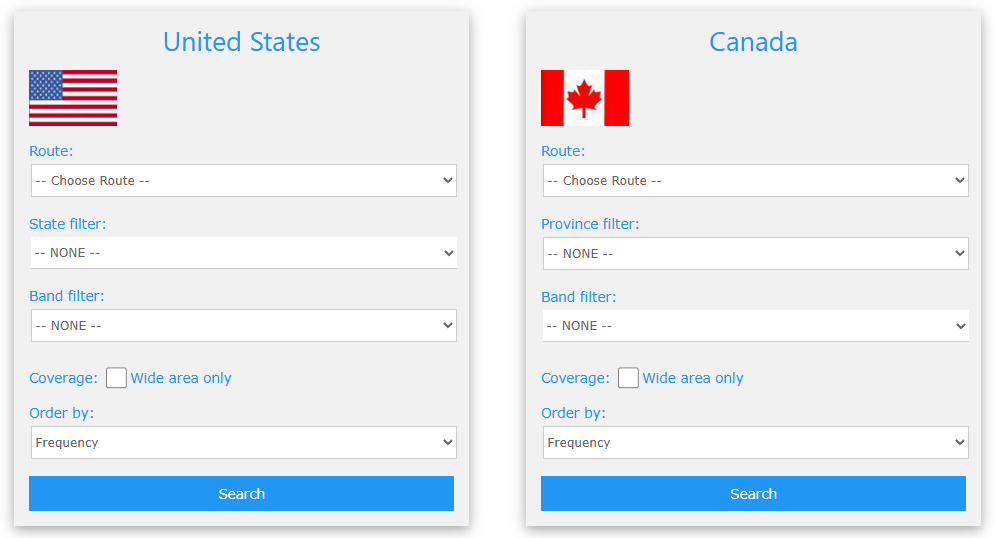
You can search routes in the United States and in Canada. You can filter by state or province, and by band. This is a tremendous boon to those of us who travel frequently with an amateur radio.
RepeaterBook to power ARRL Repeater Directory
By the way, you may not have heard this announcement made at Hamcation 2025:
RepeaterBook will be powering the next ARRL Repeater Directory! This exciting partnership greatly enhances the ARRL’s accuracy of repeater data, surely to be the hobby’s most trusted repeater directory with RepeaterBook’s extensive, real-time data.
For decades, the ARRL Repeater Directory has been a go-to resource for amateur radio operators, but with the ever-changing nature of repeater listings, keeping the data up to date has been a challenge. With RepeaterBook at the helm, the next ARRL directory will be more accurate, up-to-date, and user-driven than ever before. Get your copy!
WPSD operating system upgrade announced
The following is quoted from an announcement posted by W0CHP on the WPSD Project Discord channel on Sunday, April 6. I will note here that I usually do not immediately upgrade to something new, preferring to wait a bit until some inevitable problems get ironed out.
« begin cut-and-paste from Discord »
New Bookworm Disk Images Released
Raspberry Pi Universal disk image (RPi 2, 3b+, 4, 5, and Zero 2W)
ZumSpot OLED (mini 1.3) and ZumSpot LCD/Nextion (Mini 2.4 & Elite 3.5)
Skybridge Max/Plus from BridgeCom Systems
What’s Changed
Latest Bookworm OS release (v12.10)
Upgraded Kernel to v6.12.20
Improved WiFi reliability
All 64-bit chips/SBCs will automatically load and use 64-bit Kernels
Boot-up times are sooooooo much faster.
How to Upgrade
This is not a simple “update.” It’s an operating system upgrade. Ergo, you will need to flash these disk images on an SD Card.
Make a backup of your WPSD configuration from the Configuration page and then restore that after you fire up the latest disk image you have flashed.
Hint: after you flash the new disk image to an SD Card, you can place your WPSD Configuration Backup Zip file AND/OR your network connection profile(s) in
/bootof your newly-flashed SD card, and it will automatically put things back the way they were, and you’ll be up and running in mere minutes, just the way you had it previously.
« end cut-and-paste from Discord »
Also, Pi-Star has a version 4.3.3 Beta release available. It’s been a while since Pi-Star binaries were updated, but it looks like we’re heading to a new release very soon! Please be aware that you’ll have to flash a new microSD card for this upgrade, and since it is beta, proceed at your own risk.
Node 578492 audio sample
I captured audio from the AllScan ANH100 node 578492 to my computer as a demonstration of the audio quality. You might remember that I suffer from a ton of radio frequency interference (RFI) in my location. That makes the resulting audio capture even more astounding to me. I’m impressed.
This is not the best audio I’ve achieved, but I think it is better than “good enough.”
That audio still has a bit of clipping of peaks in the signal but I’m able to adjust that easily on the receiving handie talkie by turning down the volume knob a tiny bit. Audio waveforms were observed in real time in Audacity while I recorded several samples for this newsletter.
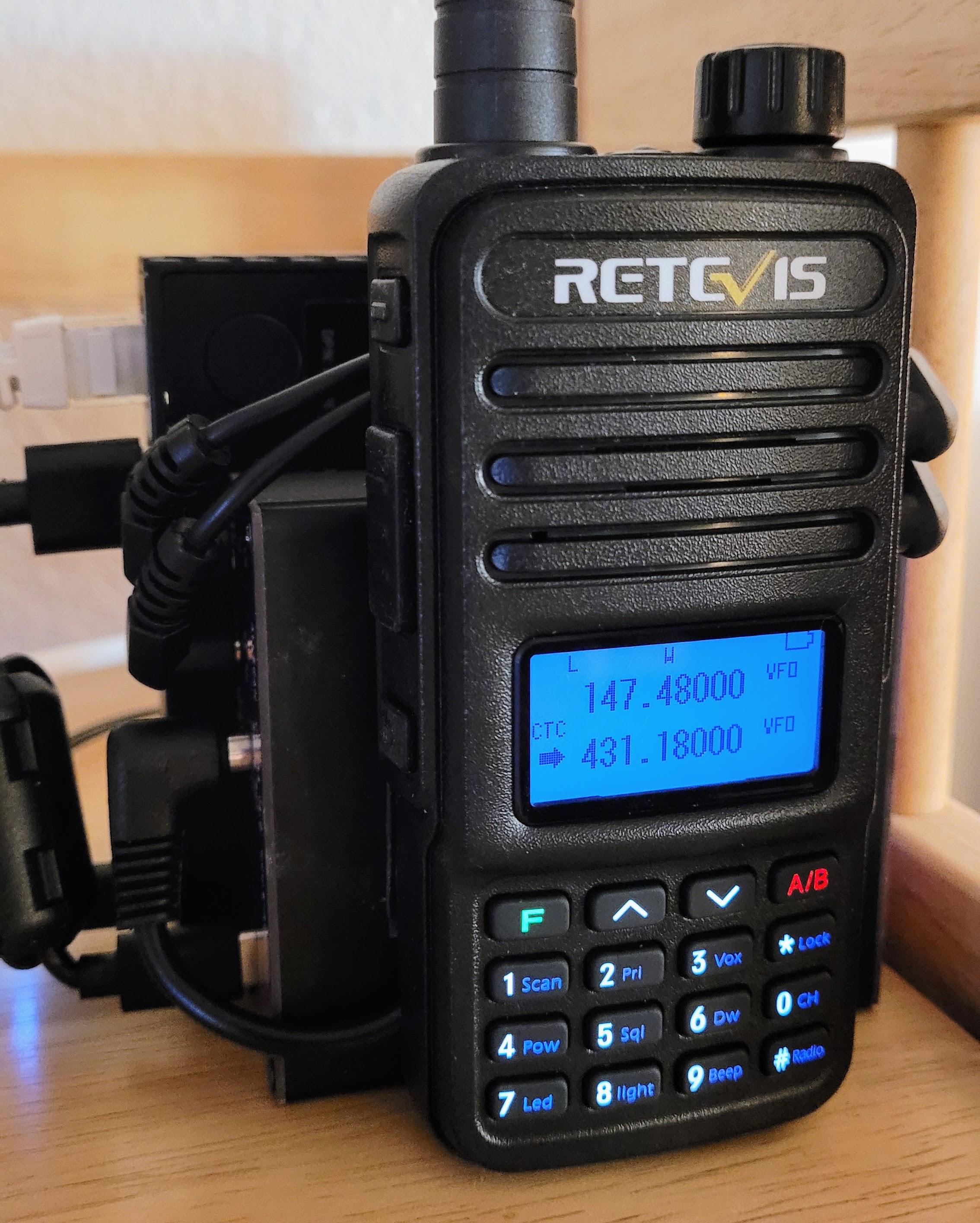
The node is an AllScan ANH100 set to local parrot. I transmitted to the node using a TIDRADIO TD-H3 handheld. The node then parroted my audio back to a Retevis RT85. The earphone jack on the RT85 was connected to a mic-to-USB adapter that was plugged into my laptop. I captured audio directly into Audacity, setting the audio source as the mic-to-USB adapter.
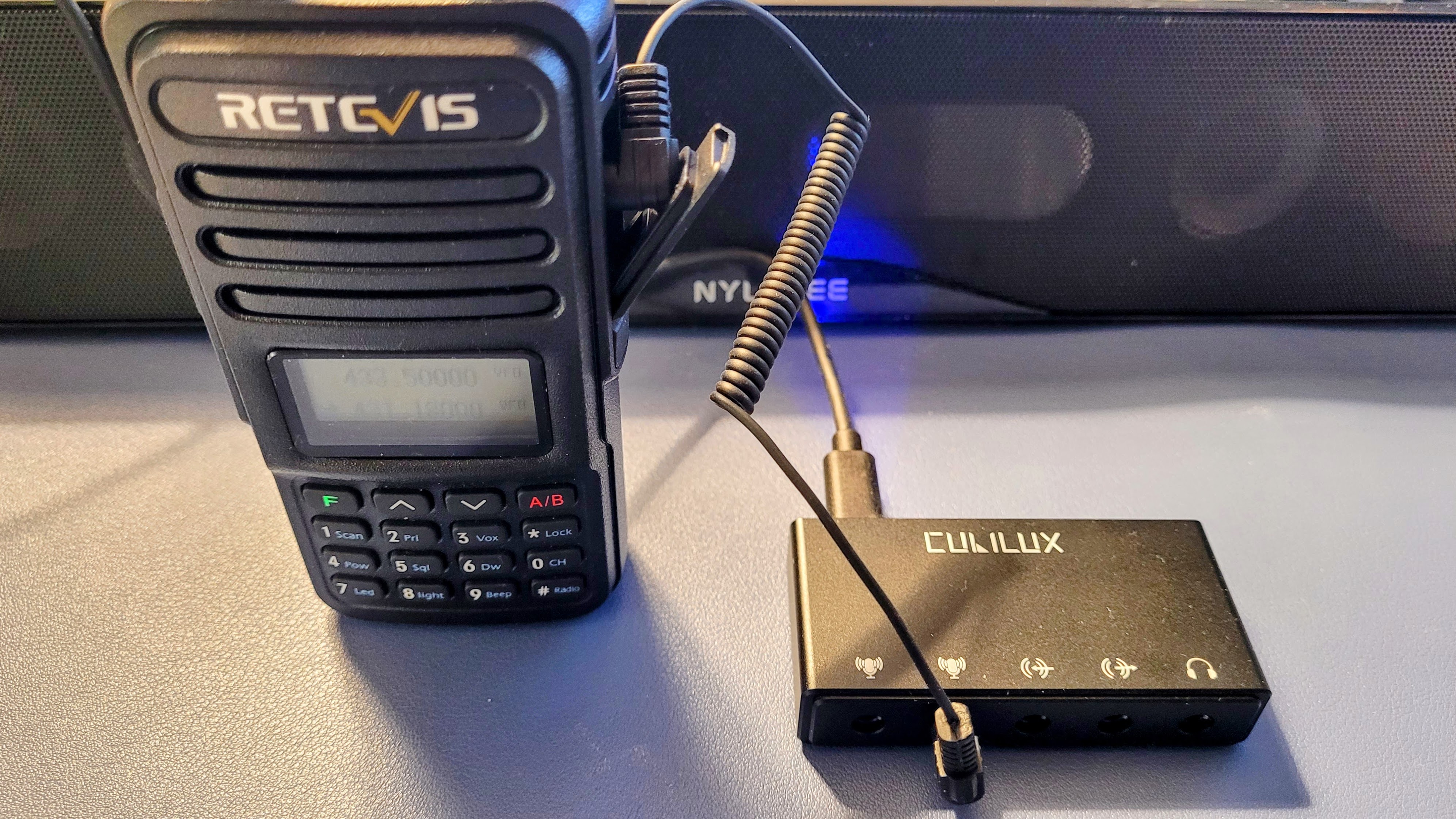
I am still fiddling with the RX and TX settings in /etc/asterisk/simpleusb.conf to help make the audio just a bit smoother, but overall, I’m quite pleased. Many, many thanks to David Gleason NR9V, maker of the ANH100, for tutoring me as I worked to understand audio quality concepts and actions. I learned a lot.
AllScan MA1 microphone adapter
I tried a cheaper Icom-brand microphone (if there is such a thing!) with an AllStar node and found it just didn’t work at all well. I couldn’t get any volume out of it.
To adapt it to the node, I used the AllScan MA1 Microphone Adapter. The “mic in” side accepted the RJ-45 plug from the microphone, and then the node side of the adapter took an RJ-45 plug out to the node’s 8-pin round plug input.
After some conversation with David Gleason NR9V, I tried it again by turning both DIP switches inside the adapter to the OFF position. Below, you see the two switches as they came from David, before I turned the one switch off. I’m sure you’ll also note, as I did, how neat this layout is. The internal assembly slides out of the case once you remove one end plate. Very nicely done.
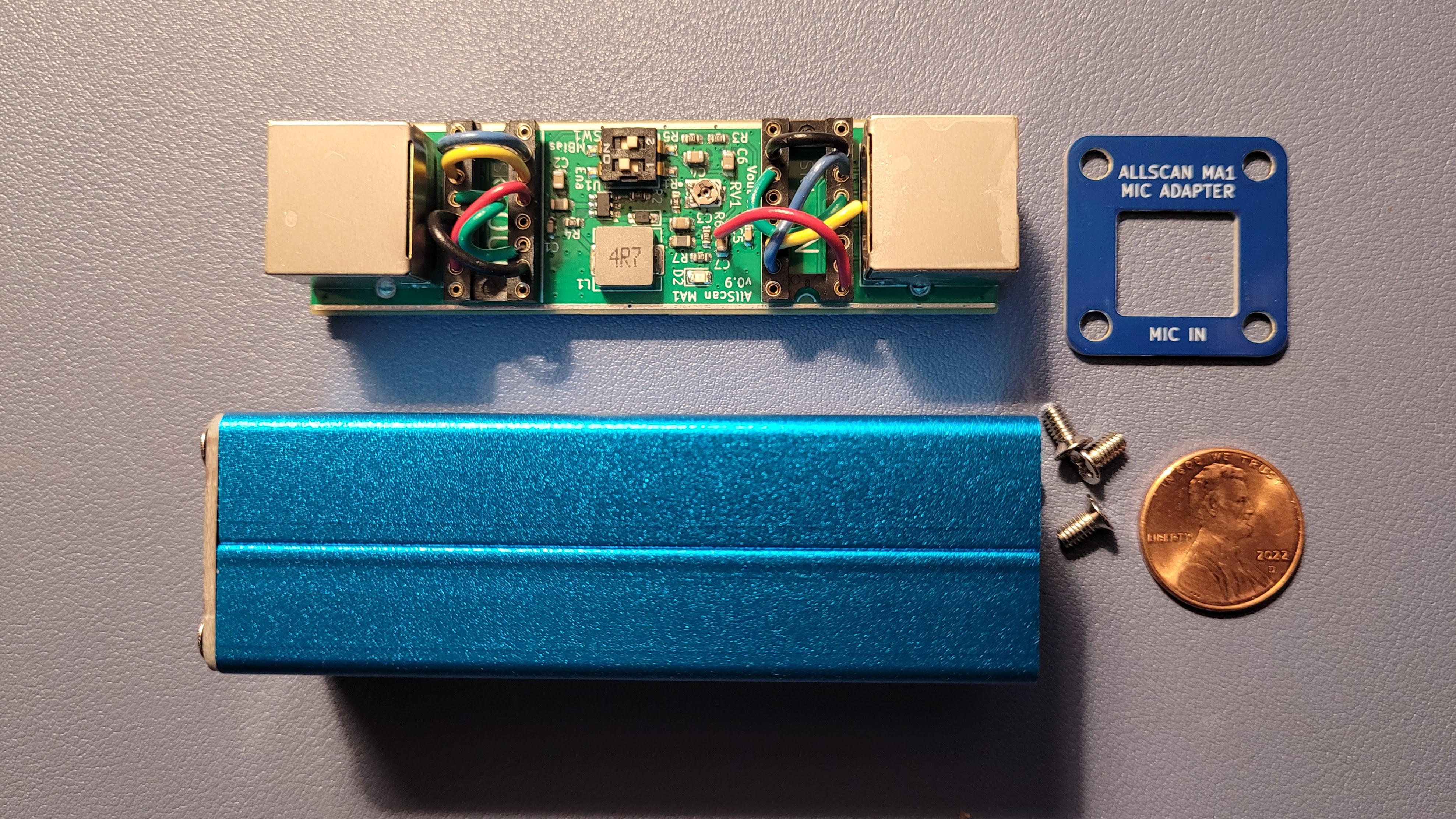
I did get more volume by changing the DIP switches but the microphone produced a strange harmonic whining noise on transmission. That whine came through clearly when the Enhanced Parrot 55553 node repeated my test transmission back to me.
That’s unfortunate because the microphone looks to be very robust.
David recommends other microphones so I’ll try a Motorola mic next:
Enables a wide variety of mics to be used with the UCI120 or various radios or other interfaces. Internal DC-DC converter supports any mic supply voltage from 5-14V. Demo Video w/Icom HM-154T, Motorola HMN-1037B, and Kenwood KMC-18 DTMF mics.
The next hand microphone I’ll try will be a Motorola HMN1037B DTMF microphone. This will require a new MA1 adapter. (I’ll keep the old adapter in case I try another Icom mic, but with a bit of soldering, I can convert it to one that works with Motorola mics.) More on this later, once the Motorola microphone arrives (it’s due to arrive today!) and I can test it with my desktop AllStar node.
NotebookLM: Using AllStarLink without owning a physical node
I asked NotebookLM how to communicate over AllStarLink without owning or building a physical node. Since this is AI-generated, take it with a grain of salt. Nevertheless, what NotebookLM came up with is useful. This output demonstrates two things: usable information can be had using NotebookLM, and there are many ways to utilize the AllStarLink system without having to own or build a physical ASL node.
From NotebookLM
« begin copy-and-paste from NotebookLM »
Based on the information in the sources, an amateur radio licensee can communicate over AllStarLink without owning or building a physical node through several methods:
Using a SIP telephone or ATA (Analog Telephone Adapter): You can configure a SIP telephone or an ATA connected to a standard phone to directly access an AllStarLink node. This requires configuring the SIP account on your device with the IP address of the AllStarLink node, a SIP extension number defined on the node, and a password. Once configured, you can dial into the ASL node and then use DTMF commands to link to other nodes. Hanging up only disconnects your phone from the ASL node instance, and redialing will restore your session if the link is still active.
Utilizing Software Clients (Softphones): Several software applications allow radioless connections to the AllStarLink network from various devices. These include:
DVSwitch Mobile (Android): This Android application allows connection to AllStarLink nodes over Wi-Fi or cellular data. It supports a “WT” (Web Transceiver) mode, which might allow connecting to specific nodes. You may need an AllStarLink username and password for setup.
RepeaterPhone (iOS): This iOS application can connect to AllStarLink nodes using public authentication or node-specific credentials.
Zoiper (macOS, Windows, Linux, iOS, Android): Zoiper’s free version can connect to AllStarLink nodes via the IAX protocol. You would need to configure it with the node’s IP address, port number, and a password if required by the node. PTT functionality in the free version may involve dialing DTMF tones.
IAXRpt (Windows): IAXRpt is a Windows “soft phone” specifically designed to connect to AllStarLink nodes. It requires setting up an IAX account on the AllStarLink node and configuring IAXRpt with the node’s IP address, a username (typically
iaxrpt), and a secret password.Transceive (macOS): Transceive for macOS allows amateur radio operators to connect to their AllStar node, monitor traffic, and transmit audio.
Accessing via a Local AllStar-Connected Repeater: If you are within range of a local amateur radio repeater that is connected to the AllStarLink network, you can potentially use your HT (Handheld Transceiver) and DTMF commands to access and control connections to other AllStar nodes. The availability of these commands and whether they are enabled depends on the repeater owner/trustee. You can often find repeaters listed as AllStar nodes on platforms like RepeaterBook.
Using the AllStarLink Web Transceiver: The AllStar Portal provides a Web Transceiver that allows users to connect to AllStarLink nodes that have enabled web access. These nodes are often indicated with a “wt” next to their number on the AllStar Node List. You typically need to be logged into the AllStar Portal to use the Web Transceiver.
Utilizing the Telephone Portal: AllStarLink has a telephone portal where you can dial a specific phone number and enter your AllStar account PIN to access nodes that have this feature enabled. The phone number for the portal is not directly provided in the sources, but it is mentioned as a way to access AllStar without a dedicated node.
Connecting through Echolink: Some amateur radio nodes are connected to both Echolink and AllStarLink. By connecting to such a node via the Echolink application (available on various platforms), you might indirectly participate in the AllStarLink network if that Echolink node is currently linked to AllStar nodes.
It is important to note that for methods involving direct SIP or softphone connections to an AllStarLink node, the owner of that node must have configured it to allow such incoming connections. Similarly, the Web Transceiver needs to be explicitly enabled on a node for it to be accessible via the web.
« end copy-and-paste from NotebookLM »
Audio version
NotebookLM also automatically produced a two-person podcast of the content. I know many of us don’t like the canned voices used by NotebookLM. (Personally, I don’t like how they say the paths to files, like to the /etc/asterisk/extensions.conf file. I’d like to be able to tell NotebookLM to just spell it out.) But since there are folks who’d rather hear something than read something, I am including the following 18-minute audio-cast for those who would rather listen.
Conclusion
AI is becoming more capable at providing answers to technical questions. What I asked is relatively simple. If I had dug up the 10 sources used by NotebookLM and summarized that information, it would have taken several hours. It took NotebookLM several minutes. As much as we might not want to use AI, it is another tool in our amateur radio toolbox. I am finding it useful.
Sangean MMR-88 emergency radio
It’s not amateur radio, but it is radio, and emergency radio intersects with our amateur radio universe.
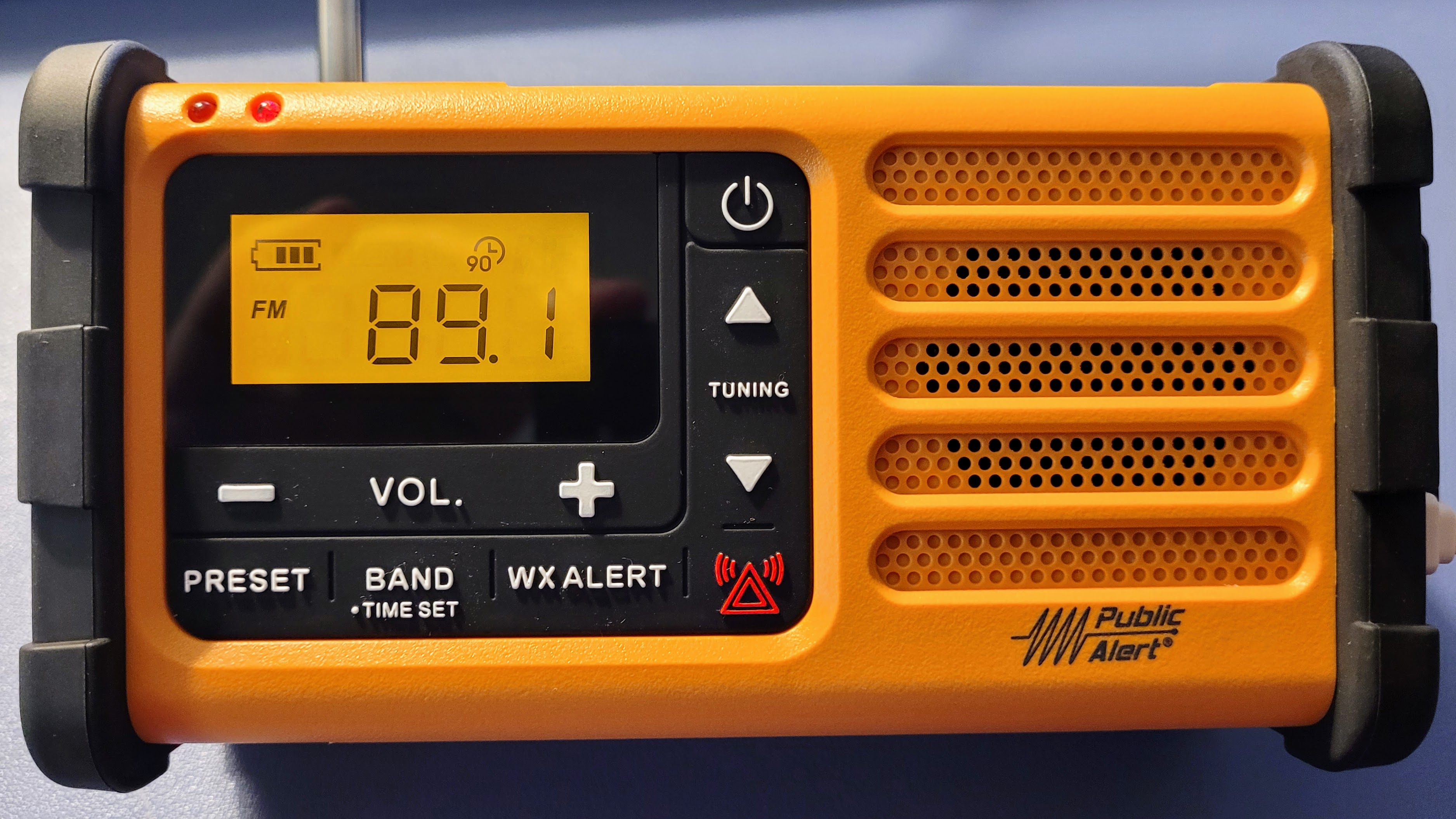
This is good looking radio with a rechargeable battery, solar panel on top, and a charging crank on the back. Charging is normally accomplished via a USB-A to micro-USB cable.
The device is shaped like a brick. In fact, it’s actually about the size of a brick.
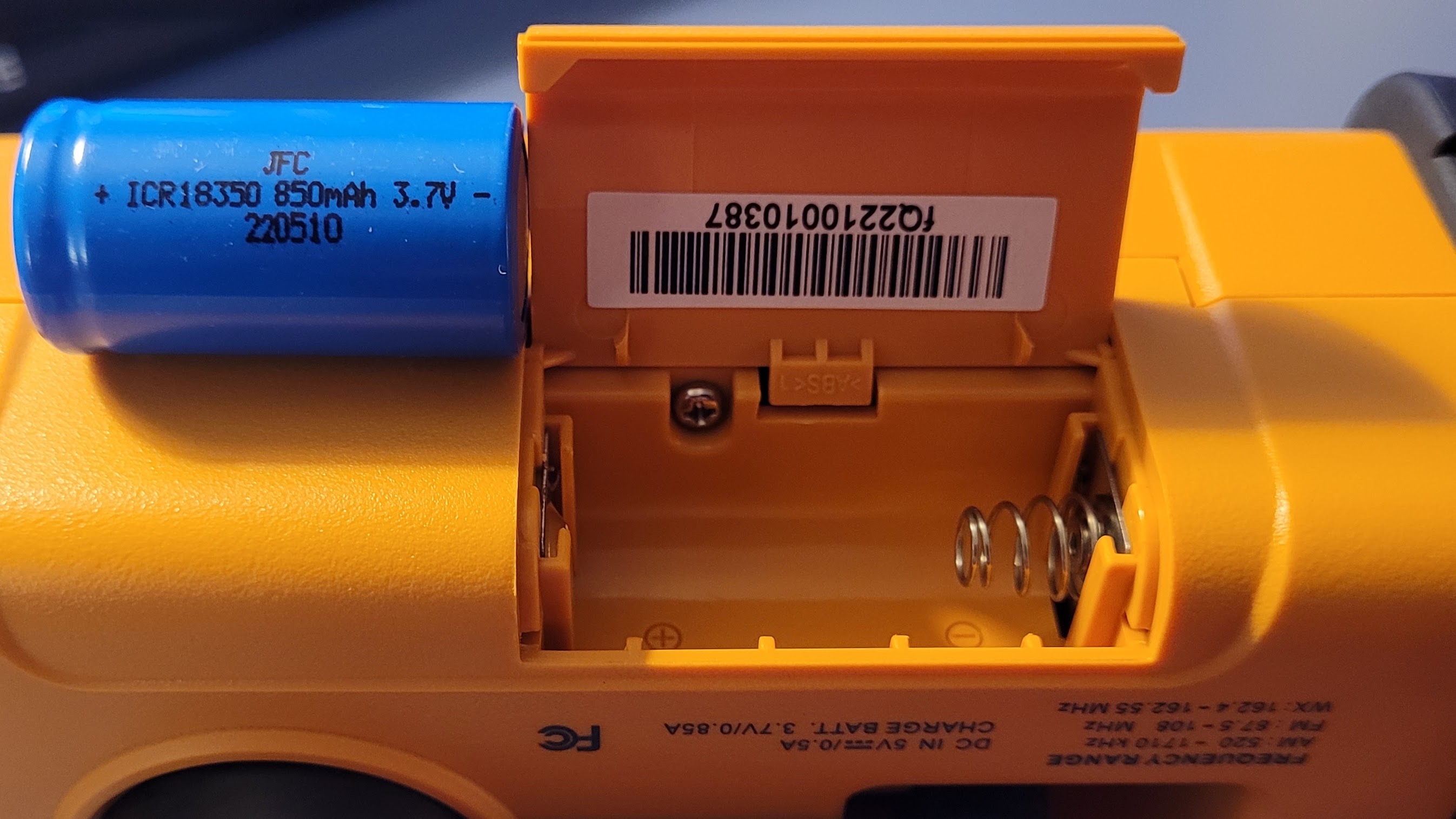
The battery compartment holds a single rechargeable ICR18350 lithium ion battery. Spare batteries are inexpensive on Amazon.
It has a USB-A port to allow charging another device from the radio, up to 500 mAh.
A built-in ferrite rod antenna covers the AM band. A telescoping antenna covers FM and weather bands.
Here is an audio capture of one of my local FM stations being received on the Sangean MMR-88. I find the sound quite pleasant for a small emergency radio. The MMR-88 would sound nice in a tent, camper, or vacation cabin…or even at your bedside.
The advantage of a simple radio is it is easy to use when the chips are down. To select a band, press the BAND button. The radio will cycle through AM, FM, and NOAA weather channels with each press. You can save stations with the PRESET button. Tuning buttons are clearly indicated, as are the volume controls. It doesn’t get much simpler than this for an emergency radio.
Of course it has a flashlight. I have to say it’s not very bright but it does the job. Press once for a steady beam, press again for a blinking light, and press a third time for the light to blink an SOS pattern. A siren can be activated but I confess I didn’t try it.
There is a headphone jack but no headphone is included in the package. You get a USB-A to micro-USB charging cord and a wrist strap.
This radio is available on Amazon for $58.44 when I wrote this. I have no complaints about this device.
TIDRADIO TD-H3 accessories
I picked up a TIDRADIO speaker-mic for my TD-H3 radios and I don’t like it. My transmissions come across a bit muffled and the speaker is definitely tinny. I can make my audio sound clearer if I speak into the microphone hole at the base of the mic, but frankly, I don’t want to have to remember to do that. I’m sure I’ll use it when I want to have the radio in my pocket but for the most part, it is not going to be a preferred accessory.
On the other hand, I also bought a stubby antenna. This accessory I like. It resembles a Diamond SRH805 Tri-Band antenna. It is very convenient around the house, compared to the standard flexible whip. Since the TD-H3 radio is a compact handie talkie, the stubby antenna makes it very easy to slip into a pocket and carry.
I will add here that transmitting with the stubby antenna makes the antenna warm to the touch. That means RF is getting converted to heat, and that means less RF is actually getting “out.” In my situation, that’s fine, but you should be aware of it if you were thinking of purchasing the short antenna.
My most recent TD-H3 radio is the clear model, available on Amazon for $33.99 when this was written. I guess it’s obvious I like this device.
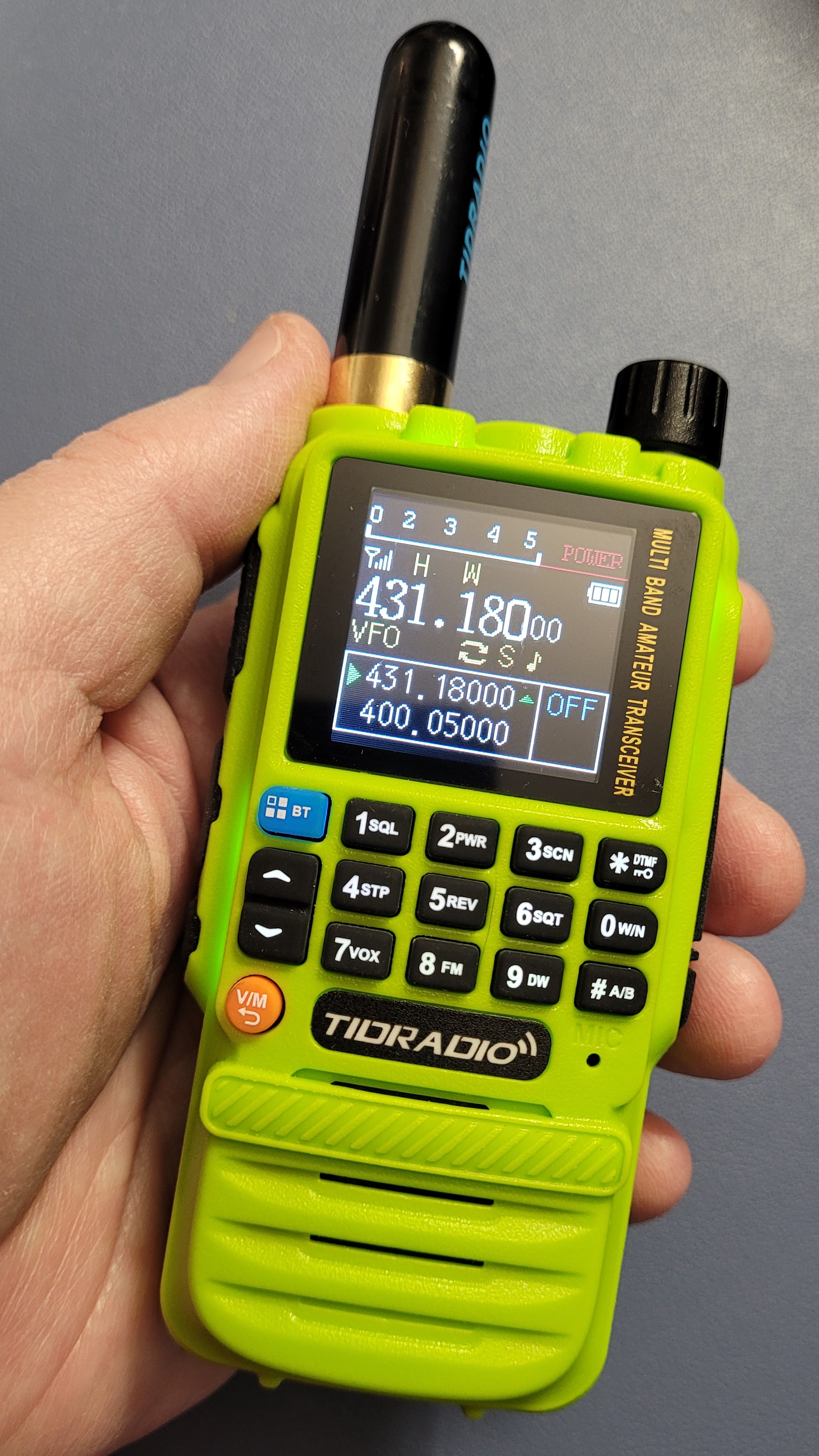
My first TD-H3 is the bright green model. It’s hard to lose. Here it is with the TD-805S short antenna.
In the next Random Wire issue, I’ll quickly review how to upgrade your TD-H3. I had a problem finding a Windows 11 driver for the CH340 programming cable, but eventually, I did find one and got it installed. After that, upgrading the firmware to the latest version went very smoothly. More coming in Random Wire Review issue 127.
IRLP: What is it?
What is IRLP and is it still relevant?
“The Internet Radio Linking Project was started back in November of 1997 as an attempt to use the internet to link radio systems across Canada.” Today, there are IRLP nodes all over the planet in frequent (sometimes constant) use.
How does it work?
The IRLP uses a Voice-Over-IP (VoIP) streaming software called Speak Freely. Speak Freely is very similar to other VoIP software packages (such as Microsoft NetMeeting and VocalTec iPhone) with one difference… It runs under Linux.
In summary, IRLP works like this (according to https://www.irlp.net/):
Sample the audio using an analog to digital (A/D) converter.
Compress the audio by downsampling the stream and using an 4-bit ADPCM algorithm to reduce the size of the stream by a factor of four (32000 bps)
Split the sample into small chucks (or packets).
Transmit the packets to the remote host using a User Datagram Protocol (UDP) stream.
Receive the packets on the remote host.
Join the split packets back into a 4-bit ADPCM stream.
Uncompress the ADPCM stream back into an 16-bit raw stream of audio.
Play the raw audio stream through a digital to analog (D/A) converter (the output device of your sound card).
You can find a lot more information about IRLP at these links:
How does it sound?
I listen to the W7RAT repeater frequently when I’m in the Portland, Oregon area. This is an FM repeater at 440.400 MHz, dedicated to IRLP usage. Michael Bloom W7RAT is the human behind the repeater. I’ve visited with him a few times on the air. Michael is a pretty interesting person, as is his company.
W7RAT operates an IRLP (Internet Radio Linking Project) repeater. Node 3039, Portland, Oregon. Frequency 440.400 P/L, +5.0MHz split, tone 123 Hz. This node is located at the 500-foot level of KOIN-TV’s broadcast tower and provides wide coverage of the Portland/Vancouver metropolitan area. For node status go to www.pdxirlp.net.
The tower location is viewable in Google Maps.
But how does it sound? I find it compares favorably with AllStar when there are radio-based elements involved. A conversation through AllStar nodes that don’t have radios is often crystal clear. IRLP depends on RF so there is always a radio involved somewhere in the exchange. To me, there is a continuum of audio quality available in analog voice over the internet, with Echolink being perhaps the worst sounding, IRLP sounding better, and AllStar sounding the best. (I want to clarify that I’m not including digital voice modes like DMR, C4FM, and D-STAR in my observation.)
Echolink uses the GSM codec from the early 1990s. IRLP is focused more heavily on audio quality but still depends on analog sound cards. AllStar uses modern audio codecs and has the advantage of being able to operate in full duplex mode so you can hear if you double with another station.
A note on checking your audio quality
Having opined here on audio quality, let me also say this: it should be a best practice to test your audio quality. I hear a lot of variability among AllStar nodes with overmodulated signals (too loud), undermodulated signals (too quiet), interference of some kind, speaking too close to the mic, being too far from the mic, and not keeping the transmit button firmly activated during the transmission. One way to correct these issues is to ask a friend to evaluate your signal. This works for Echolink, IRLP, and AllStar. If you are using AllStar, an easy way to check your audio is to use the Enhanced Parrot node 55553 to hear how you sound to others. (And a shout out to Patrick Purdue N2DYI who is the amateur behind node 55553.)
The audio clip above includes an open squelch at the beginning of the capture so that I could evaluate clipping of the audio signal. While I wanted to record some IRLP audio, instead I made this capture with my AllScan ANH100 node 578492, using a TIDRadio TD-H3 to transmit to the node. Audio is captured from a Retevis RT-85 wired through an adapter to my laptop, with Audacity used to record the audio.
Is IRLP still relevant?
The short answer to this question is: yes! As you can see from the listing of connected nodes at https://status.irlp.net/index.php?PSTART=2 there are many nodes active around the world. A simpler view is to look at the number of nodes by country at https://status.irlp.net/index.php?PSTART=5. Nodes are often connected to many other stations by radio, so it is clear that IRLP remains an active and worthwhile choice for many amateur radio operators.
A new ARM-based laptop
I had to smile as I made the decision to buy a new laptop based on an ARM processor. Would it feel like a Raspberry Pi on steroids or like an actual laptop computer?
I took advantage of good pricing during Amazon’s spring sale to buy a Microsoft Surface Laptop 7. This laptop has been a bit controversial because it is based on an ARM processor instead of an Intel or AMD processor. Before making the purchase, I read many reviews, hoping to find some clarity. While I did not find certainty, I learned enough to let me roll the dice on this device.
And so far, so good. After a few hiccups during the configuration phase (my fault), the machine is humming along nicely.
(I’ll make just one criticism about Amazon, but before I do, let me say this is very much a first-world problem. In the context of socioeconomic conditions across the entire planet, feeling perturbed because of a delay in the promised overnight delivery of a high-tech device is rather absurd. But there it is: I ordered with overnight delivery expected, then the next day it was extended, and then it was extended again. I ordered on a Friday, expecting a Saturday delivery, and received the device late on Wednesday. So: five days for “overnight delivery.” It’s not so much the delay as it is the sense of a broken promise. That makes me like Amazon just a little bit less. But the device arrived undamaged (nested inside three boxes) and in working order, so I have very little to complain about.)
So on with the report of getting started with this new computer.
MacBook Air or Suface Laptop 7?
I had narrowed down my choices to a newer MacBook Air with an M2, M3, or M4 processor, or the Surface Laptop 7 with the ARM processor. These are very different platforms in many ways, but what I was looking at was a speedy processor, a good display, portability, and reliability.
I’ve had Asus machines and while there are some attractive units from that maker currently available, I’ve encountered mechanical or electrical problems with each Asus computer I’ve owned. My nicest laptop from Asus starting having video glitches right as Covid surfaced, then Asus stopped accepting devices for repair. At that time, I bought another computer and let the Asus sit in a corner for two years. Now it is old enough that it is outdated tech.
I moved on to other brands, like Lenovo. I like Lenovo. I’ve had Dell and HP computers, but the Lenovo servers, desktops, and laptops have been utterly reliable. Not flashy, not fancy, sometimes not very fast: just reliable. That’s important, especially when I’m on the road and don’t have a backup computer at hand.
The MacBook Air has a long history of reliability and performance. I started there, but as I read reviews about the Air, I kept running into comparisons with the Surface Laptop 7. This seemed a bit nonsensical so I kept digging. I discovered that the Surface seems to have been designed to compete directly with the MacBook Air.
I really did want to re-enter the Mac world. I left it about 15 years ago as my work environments changed, but I really enjoyed using a Mac. Now that my work is primarily in a Windows environment, it made more sense to lean in that direction, as long as the hardware was on par with the MacBook.
Is it? It seems to be. While the Air and the Surface are fundamentally different platforms, I’m finding the Surface to be as satisfying as the Mac in many ways.
Slow to start
When I first booted up the Surface, I became a bit concerned. It was running slower than my not-very-old Lenovo ThinkPad X1 laptop! It took me a few minutes to realize that the system was still setting up in the background and was busy downloading updates. I let that finish and then left the computer on overnight. In the morning, the system was noticeably faster than my ThinkPad.
Erred during account setup
I made a wrong turn during account setup. To me, the prompts were a bit confusing. I have a Microsoft 365 Business account and wanted to use that as the login for the Surface. But what happened is during the account creation process, the system set up a Microsoft account with my work email address but not tied to my business subscription. That was confusing. Now I have two Microsoft accounts tied to my work email address. This continued to pop up when logging into other Microsoft services such as Teams, where I am prompted: is this for a personal account or a work account?
Eventually, I reset the laptop, taking it back in time to how it came from the factory. That went smoothly, fortunately.
For the second attempt at setting up, I used my personal Outlook.com account for the laptop. Once the Surface was up and running under that identity, I logged into my Microsoft 365 applications using my business account. That worked. The system is running well in this configuration.
Automatic import of apps: not so much
Microsoft offers to import the applications and settings from another Windows machine. I assume they used my Outlook.com account to know these things. I said yes and ended up with a bunch of shortcuts that didn’t go anywhere. My apps from the ThinkPad showed up in the Surface start menu, but the apps weren’t installed.
(And interestingly, the shortcuts on my Surface desktop pointed to OneDrive locations, and when I started deleting the shortcuts, I was warned it would delete the link and the app everywhere I had it installed! I’m sure someone thought this was a great feature but I think it is a bit of a disaster.)
I spent a few hours the next day actually installing and configuring some of the daily apps I use, including:
Tailscale – For easy VPN connections between most of my machines.
PuTTY – For SSH connections to various AllStar nodes and Linux machines.
LogSeq – For daily journaling. The journal files live in a OneDrive folder.
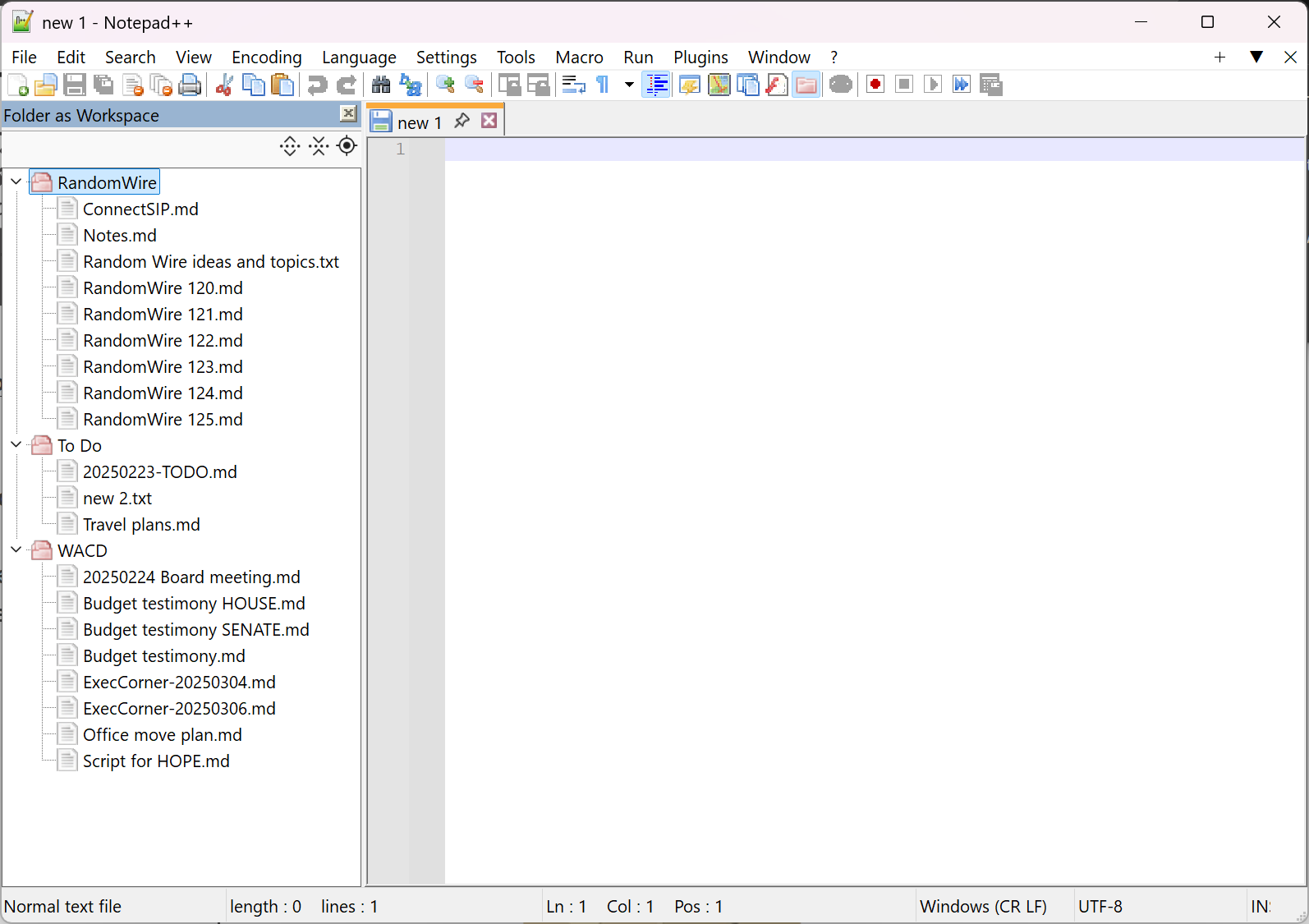
Notepad++ – For notes, Markdown editing, HTML and PHP editing, and more. Folders I use as workspaces live in OneDrive folders.
Joplin – For current notes but I’m shifting to LoqSeq journals and Notepad++ workspaces instead; Joplin has thousands of pages of historical notes. Those notes live in a Google Drive space but I note that responsiveness has declined as the number of notes has increased.
iaxRpt – For connecting to one of my AllStar nodes over iaxRpt, and can connect when traveling by tunneling the connection over Tailscale.
Brave browser – For most web browsing.
Zoom Workplace – For video conferencing.
Audacity – For audio recording and editing.
Despite issues identified by others when installing non-Microsoft software to the ARM-based Surface Laptop 7, I have encountered no problems. So far, all is well.
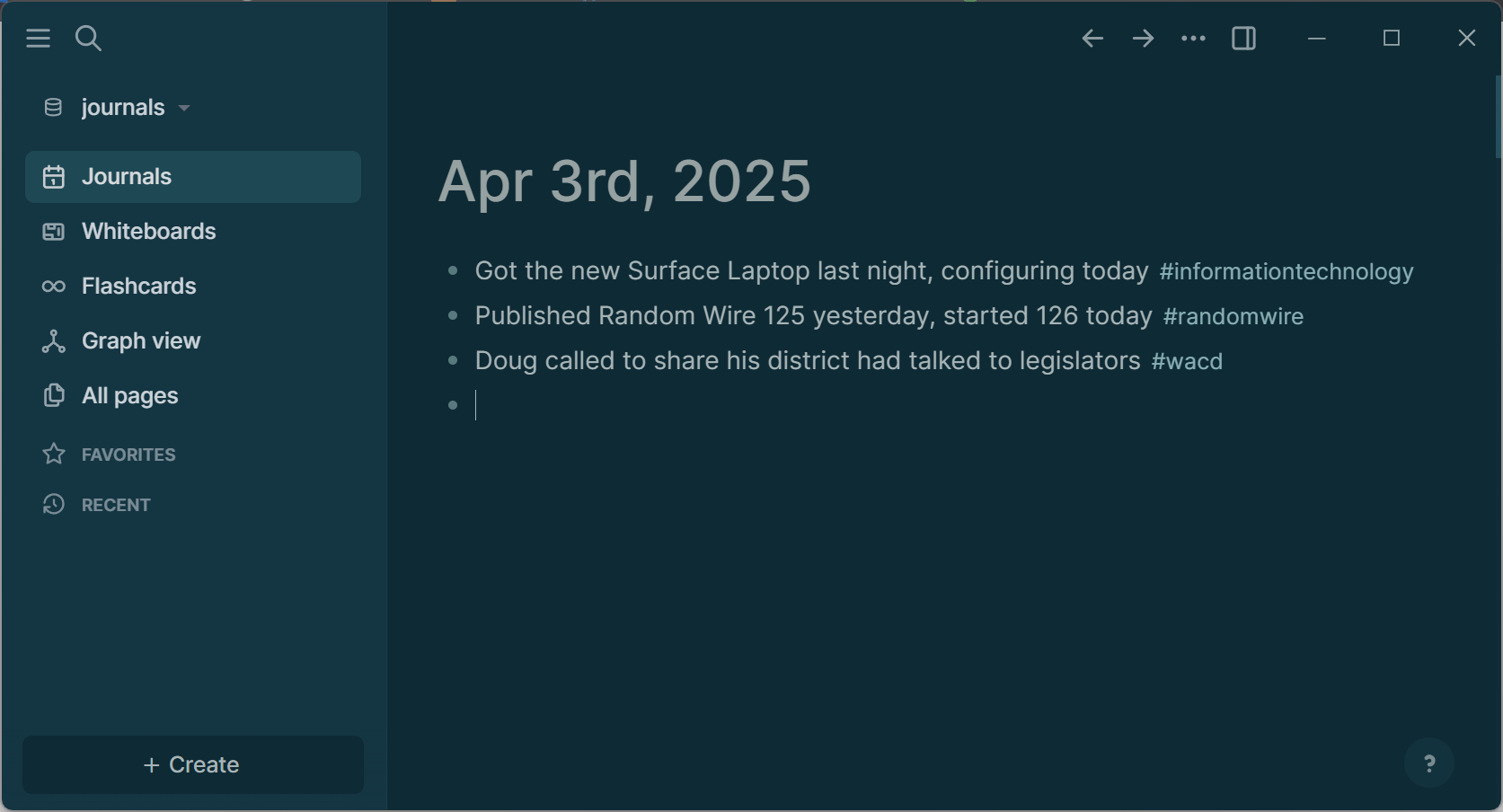
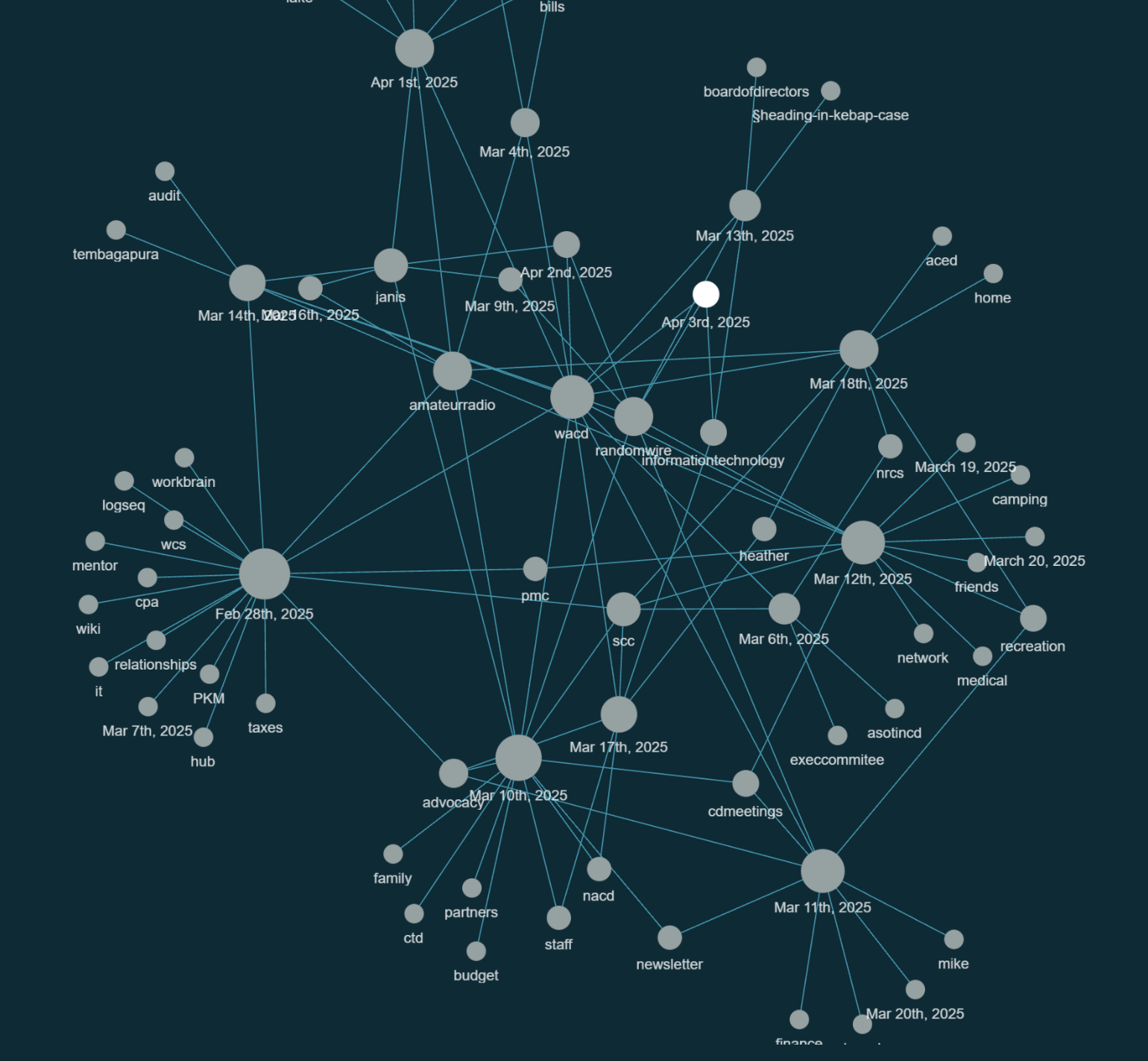
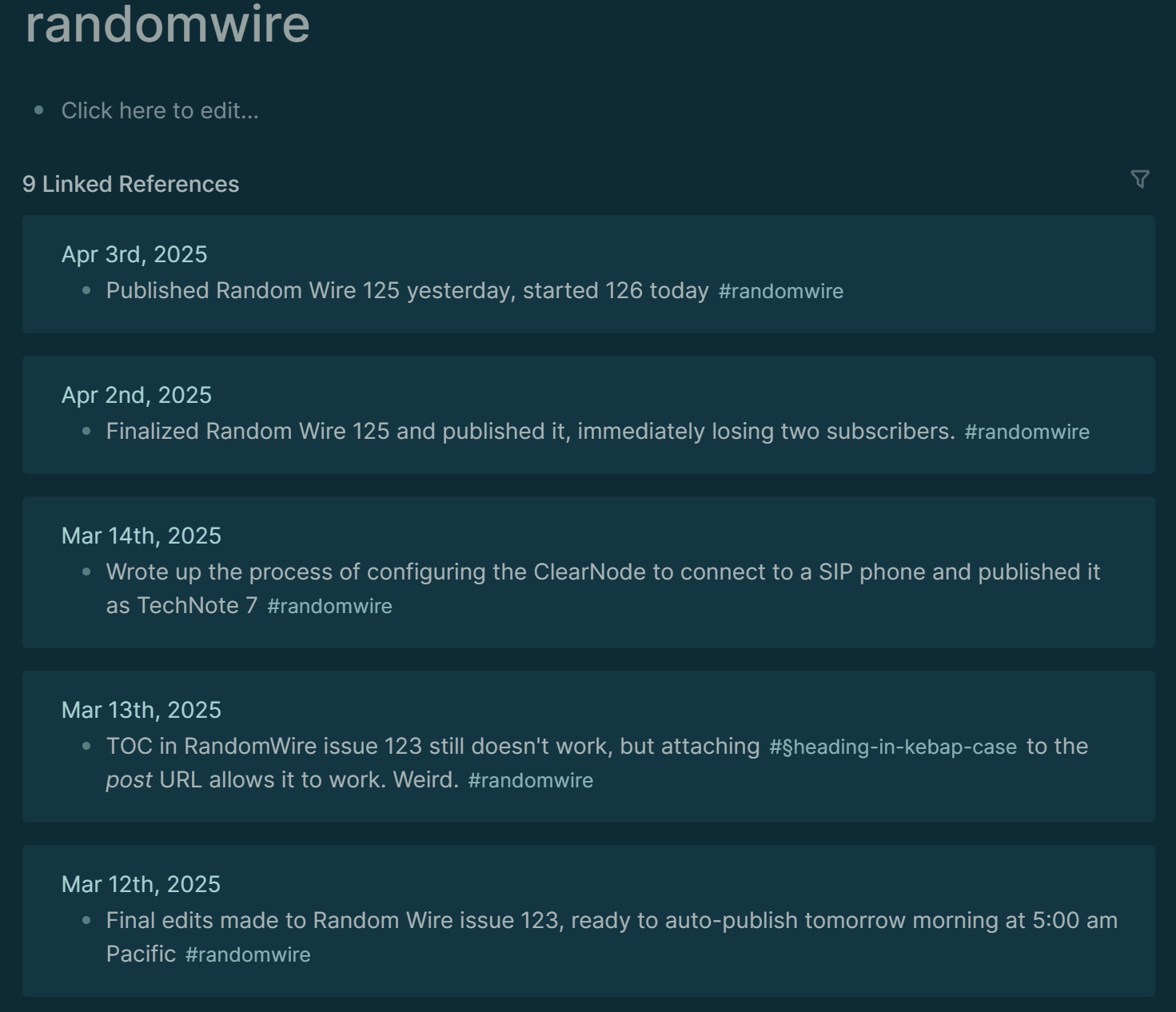
I keep a daily journal in LogSeq. It’s an interesting approach to journaling that I find works well for me, as long as I remember to hashtag each note. If I keep up on the hashtags, then I can see a “graph” of the topics and can also get a report of entries for a specific topic. That makes it easier to generate my monthly activity report.
The graph view shows the topics (hashtags) used by day. Is it strange? Yes, but perhaps not so strange if you’ve ever tried mind mapping.
Clicking on a hashtag gives a date-ordered list of all items with the same hashtag name. For example, clicking on #randomwire yields these notes:
I’m also experimenting with using folders as workspaces in Notepad++. I am keeping notes in Markdown format so I can use headings, links, and other Markdown goodness. Here is what three folders as workspaces looks like, as shown in the left side of the application window:
One other change I’ve made is to install a simple dashboard as my browser home page. I’m using the free version of a DAK board. In the screenshot below, I’ve obscured the Zoom meeting IDs and passwords. This dashboard pulls from my personal Google calendar and my work Outlook calendar to populate the daily appointment listing. The nature-themed image changes regularly (I have mine set to change every 5 minutes, but you can set it to as brief as every 5 seconds to as long as once every 4 hours). I also have an RSS feed at the bottom of the screen for one of my work websites.
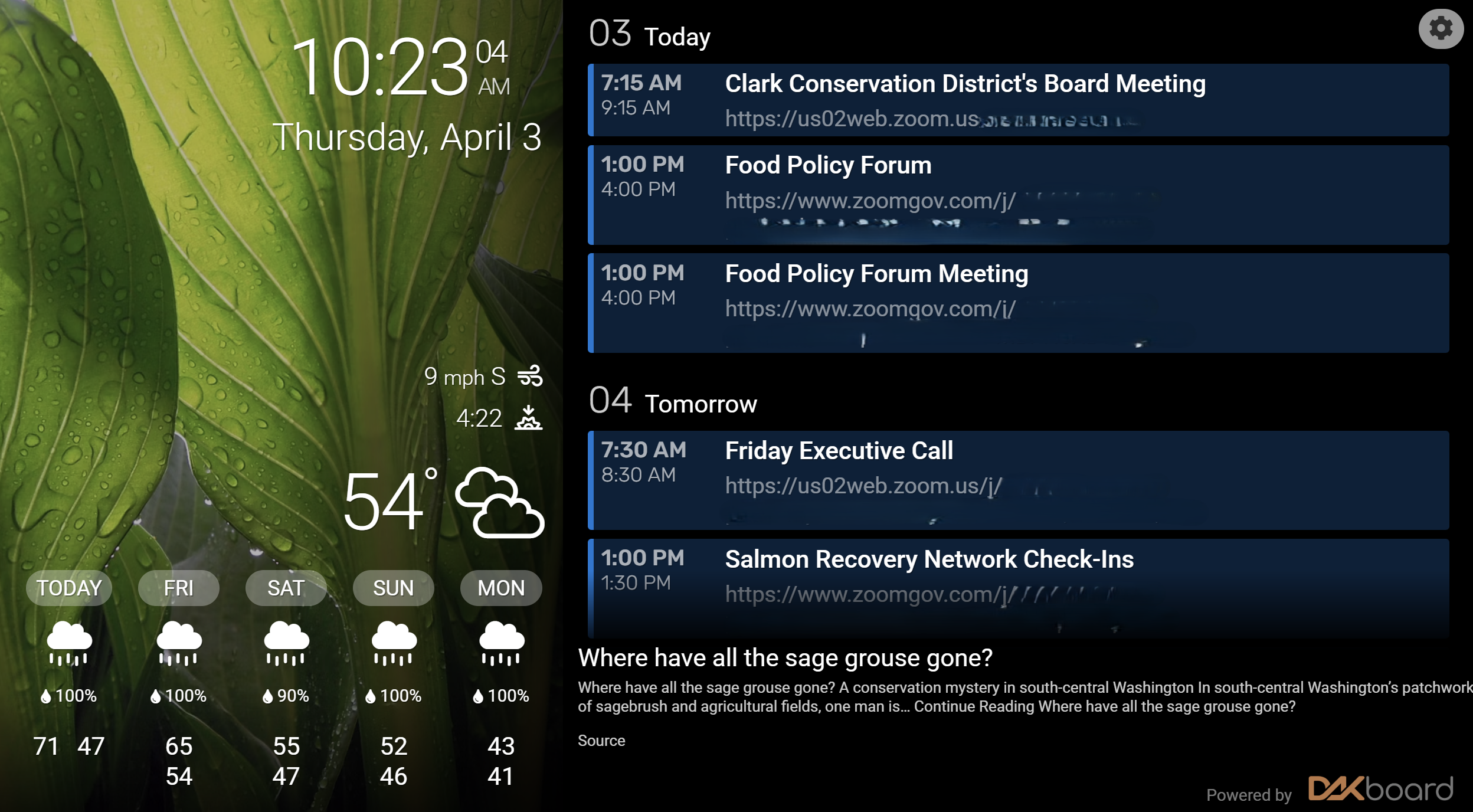
I don’t like clutter and I do like going to a single place for key information. I’m liking the DAK dashboard. It seems like a good compromise between information overload and simplicity.
Android phone storage
I’ve been watching my available storage decline over time on my Samsung Galaxy phone. A little digging showed that the Audible app was using 25 gigabytes of storage. Unbelievable.
To figure this out for yourself, in Google Play, tap on your profile picture in the upper right corner, then tap on Manage apps & devices. Partway down that screen you’ll find the amount of internal phone storage consumed by your applications. Tap on that line to get a list of apps and the storage used by each. If you need to sort the list, tap the three bars to the right of the Apps title, then select Size. That will give you a size-ordered listing.
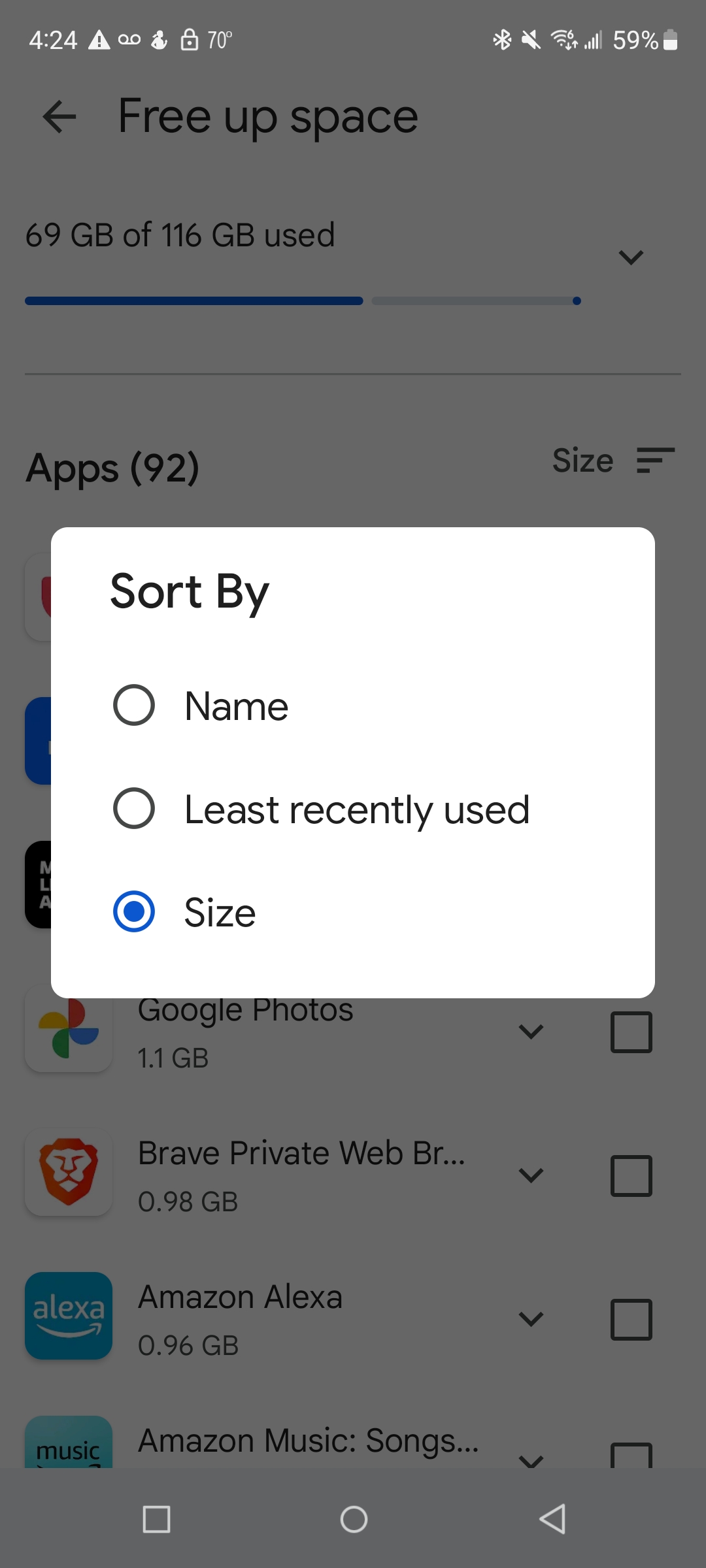
Apparently, the default is to store downloaded audio books to the main storage of the phone. I found a different setting where I could specify saving audio books to the 512 Gb microSD card. After specifying that change, I rebooted the phone.
After making this change, I saw the internal storage change from 90 Gb used to 69 Gb used. That makes the phone run noticeably faster and that makes me a little happier.
That’s a wrap. When I started issue 126, I wondered if I would have enough to write about. When you touch a radio every day, the learning and discoveries just don’t seem to stop!
73 to all,



Leave a Reply